Eduqas · GCSE · English Language
Section B (20%) – Prose Writing
This topic covers the essential skills required for Section B: Prose Writing in the GCSE English Language exam. It focuses on communicating clearly and imaginatively (AO5) while demonstrating precise technical accuracy in vocabulary, sentence structures, and punctuation (AO6).
- 7 min read
- 3 worked examples
- 5 practice questions
- 8 key terms
Study Notes
Overview
Welcome to Section B: Prose Writing. This component of your GCSE English Language examination is worth a significant 20% of your total grade. Unlike the reading sections where you analyse another writer's choices, this section places you firmly in the driver's seat. You are the writer. The examiner is looking for you to demonstrate two key Assessment Objectives: AO5 (Communication and Organisation) and AO6 (Technical Accuracy). Together, these objectives assess your ability to craft engaging, purposeful texts while maintaining rigorous control over your spelling, punctuation, and grammar.
Whether you choose the creative narrative/descriptive task or the transactional writing option, success relies on your ability to make deliberate choices about form, audience, and purpose. The most successful candidates treat this not just as an exam answer, but as a genuine piece of writing designed to evoke a specific response from the reader.
Reading Skills: The Foundation of Good Writing
Before you can write effectively, you must understand how professional writers achieve their effects. The reading skills tested in Section A (AO1, AO2, AO3, AO4) directly inform your writing in Section B. By analysing unseen 19th, 20th, and 21st-century texts, you build a toolkit of techniques to deploy in your own work.
Identifying Information & Ideas (AO1)
In the reading section, examiners award marks for your ability to locate and synthesise both explicit and implicit information. When writing your own transactional pieces, you must ensure your core arguments and supporting details are clearly identifiable to the reader, while perhaps leaving implicit ideas for them to infer, creating a more sophisticated text.
Analysing Language (AO2)
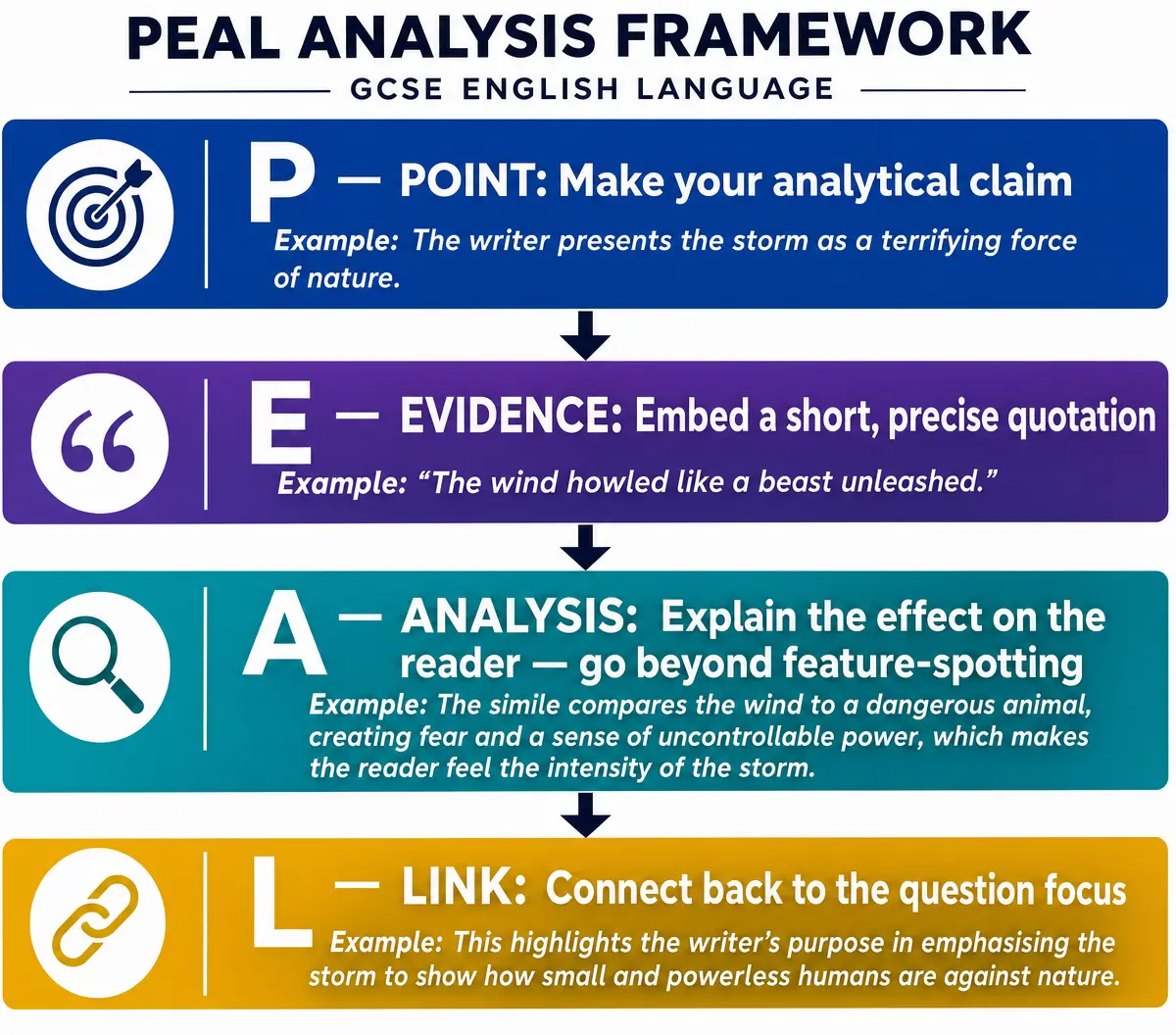
Understanding how language influences a reader is crucial. When analysing texts, you must move beyond simple feature-spotting to explore the precise effect of a writer's choices.
Key Language Features to Identify
| Feature | Definition | Effect on Reader | Example |
|---|---|---|---|
| Metaphor | Describing something as if it is something else. | Creates vivid, memorable imagery by linking two unconnected ideas, forcing the reader to see the subject in a new light. | The classroom was a zoo of feral teenagers. |
| Simile | Comparing two things using 'like' or 'as'. | Helps the reader visualise an unfamiliar concept by comparing it to something familiar. | His anger simmered like a dormant volcano. |
| Pathetic Fallacy | Giving human emotions to inanimate nature, particularly the weather. | Establishes atmosphere and mirrors the internal emotional state of the characters. | The sullen clouds wept heavily over the town. |
| Personification | Attributing human characteristics to non-human things. | Brings the inanimate world to life, making descriptions more dynamic and relatable. | The wind whispered secrets through the pines. |
| Juxtaposition | Placing two contrasting ideas close together. | Highlights the differences between the two elements, often creating tension or emphasising a specific quality. | The delicate butterfly rested on the rusted barbed wire. |
Analysing Structure (AO2)
Structure is the architecture of a text. Examiners reward candidates who can explain why a writer has organised a text in a specific way. Key structural features to look out for include:
- Openings and Endings: Does the text start in medias res (in the middle of the action)? Is the ending cyclical, returning to the opening image?
- Shifts in Focus: Does the writer move from the macro (wide landscape) to the micro (a tiny detail)?
- Narrative Perspective: Who is telling the story? A first-person perspective creates intimacy, while a third-person perspective offers distance.
- Sentence Length Variation: Short sentences build tension and pace; long, complex sentences create flowing description or build an argument.
Evaluating Critically (AO4)
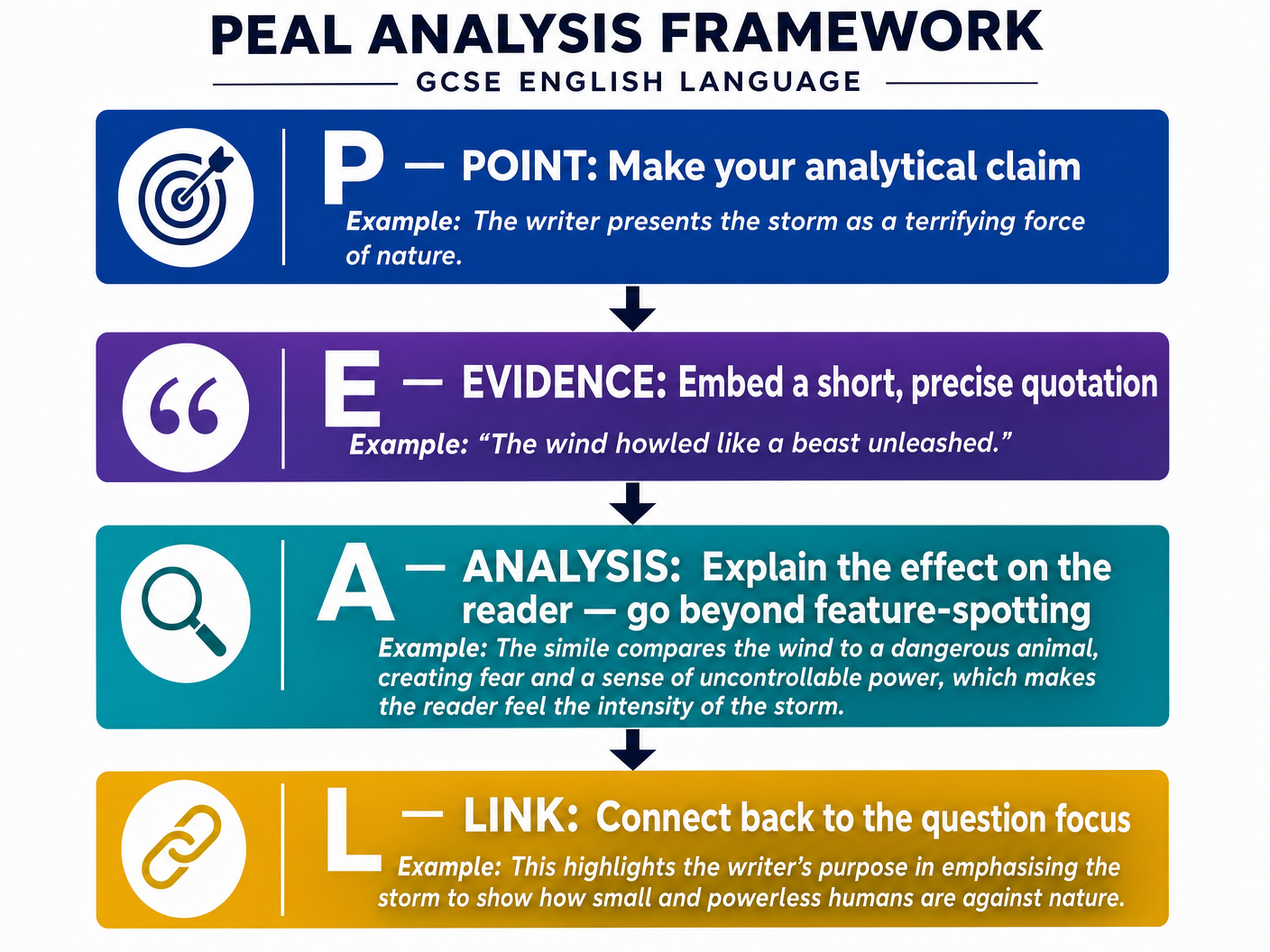
Evaluation requires you to form a judgement about a text's effectiveness and support it with textual references. You must state an opinion ("The writer successfully creates a sense of panic..."), provide evidence, analyse the methods used, and link back to the statement. This critical mindset is invaluable when proofreading your own writing: Have I actually achieved the effect I intended?
Writing Skills: Crafting Your Response
Section B tests your ability to apply the techniques you've analysed in Section A. You will typically face a choice between a creative task (narrative/descriptive) and a transactional task (writing for a specific real-world purpose).
Creative Writing (Narrative and Descriptive)
When tackling a narrative or descriptive task, your primary goal is to engage the reader's imagination.
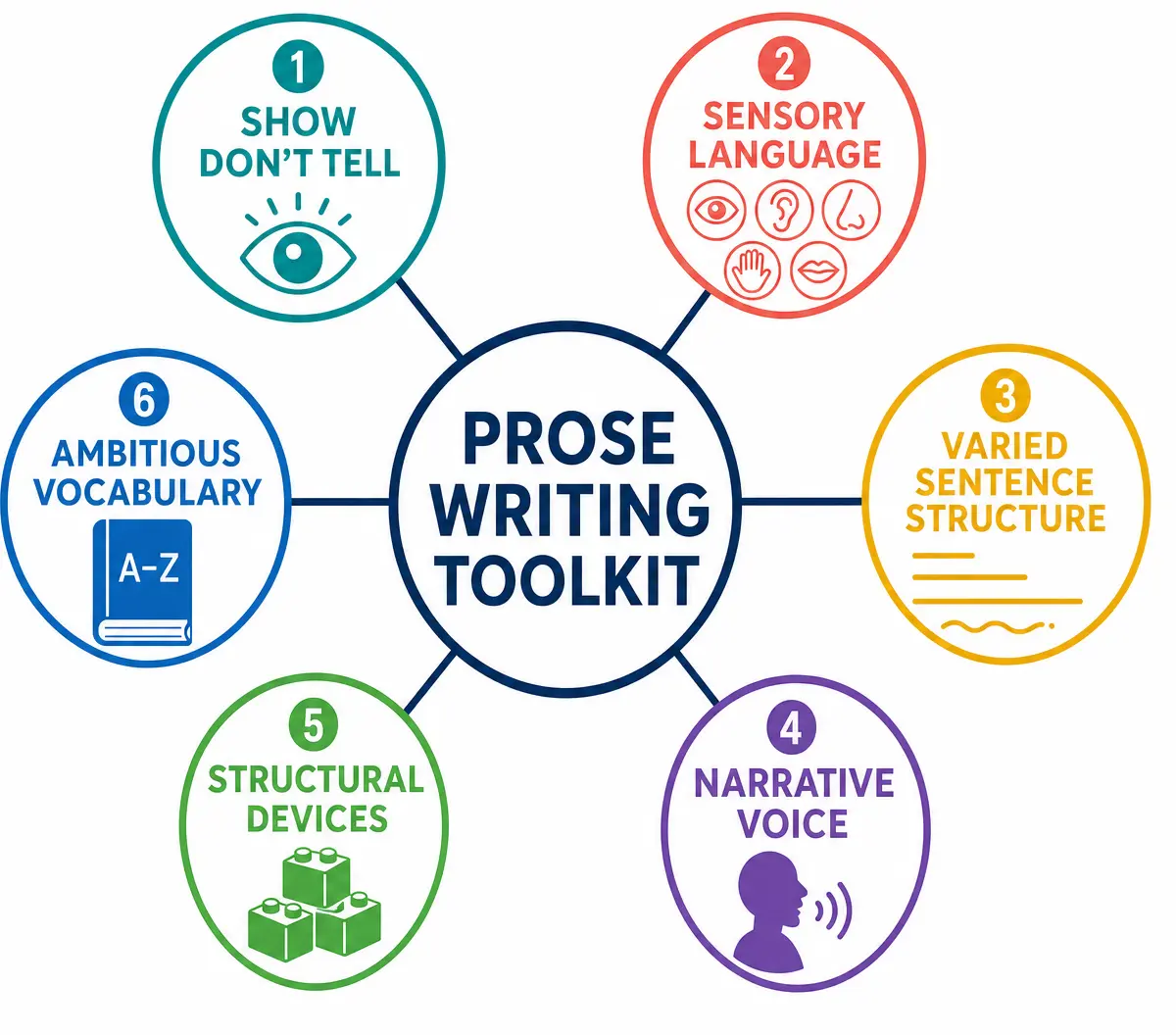
- Show, Don't Tell: This is the most critical rule for achieving high marks. Instead of telling the examiner "the man was angry," describe his "clenched fists" and the "vein pulsing in his jaw." Let the reader deduce the emotion.
- Sensory Description: Move beyond just what can be seen. Incorporate sounds, smells, textures, and tastes to build a three-dimensional world.
- The One-Scene Rule: In a 45-minute exam, do not try to write an epic novel spanning years. Focus on a single scene, a single moment in time, or a single interaction. Depth is always rewarded over breadth.
- Varied Sentence Structures: Deliberately mix short, punchy sentences with longer, complex ones to control the rhythm and pace of your writing.
Transactional/Non-Fiction Writing
Transactional writing requires you to adopt a specific form (e.g., letter, article, speech, leaflet) for a specific audience and purpose.
- Purpose, Audience, Form (PAF): Before writing, identify these three elements. They dictate your register (level of formality) and tone. A speech to classmates requires a different register than a formal letter to a Member of Parliament.
- Persuasive Techniques (AFOREST): If the task requires persuasion or argumentation, deploy techniques such as Alliteration, Facts, Opinions, Rhetorical questions, Emotive language, Statistics, and the Rule of Three.
- Structural Cohesion: Use discourse markers (e.g., Furthermore, Conversely, Ultimately) to guide the reader logically through your argument.
Technical Accuracy (SPaG - AO6)
Spelling, Punctuation, and Grammar account for half of the marks in Section B. This is where many candidates lose easily avoidable marks.
- Ambitious Punctuation: To access the highest bands, you must demonstrate control over a range of punctuation. Move beyond full stops and commas. Use semicolons to link closely related independent clauses; use colons to introduce lists or dramatic statements; use dashes for emphasis or parenthesis.
- Vocabulary: Avoid pedestrian verbs like "walked" or "said." Use precise, ambitious vocabulary ("sauntered," "bellowed") that accurately conveys your intended meaning.
- Proofreading: Always leave 5 minutes at the end of the exam to check your work. Correcting a few misplaced apostrophes or spelling errors can literally move you up a grade boundary.
Interactive Diagrams
2 interactive diagrams to visualise key concepts
Conceptual Flow Outline
English Language exam approach flowchart
Conceptual Flow Outline
Writing mark scheme progression
Worked Examples
3 worked examples — open one to explore the question and available guidance.
Practice Questions
Test your understanding — click to reveal model answers
Read the extract. List four things you learn about the house from this part of the text. [4 marks]
Hint: Only look at the specified lines. Keep your answers brief and factual. Do not analyse the language.
How does the writer use language to describe the character's fear? [8 marks]
Hint: Use the PEAL structure. Focus on specific word choices (verbs, adjectives) and language devices (similes, metaphors). Explain the *effect* on the reader.
Write a story about a discovery. [40 marks]
Hint: Plan your narrative arc first. Use the 'One-Scene Rule'—don't try to write an entire novel. Focus on building atmosphere leading up to the discovery.
Write a letter to your local council arguing for or against the closure of a local park to build a new shopping centre. [40 marks]
Hint: Identify PAF: Purpose (Argue), Audience (Local Council - formal), Form (Letter). Use AFOREST techniques to build a persuasive case.
Evaluate the statement: 'The writer effectively creates a sense of tension and danger in this extract.' [15 marks]
Hint: Give a clear opinion. Select evidence that supports the idea of tension/danger. Analyse the language and structural methods the writer uses to achieve this.